Shoot To Die
 Play
PlayExtended Contributions
- Created a custom interaction system, featuring manual weapon mechanics and fully interactable environmental objects.
- Designed a triple collision projectile system including "wiff" velocities to allow players to juggle physics actors mid air.
- Created the foundations for procedural rendering shaders that eventually evolved into the fully fledged Unreal Engine plugin.
- Translated mouse to world-space mathematics to drive player controllers and UI elements.
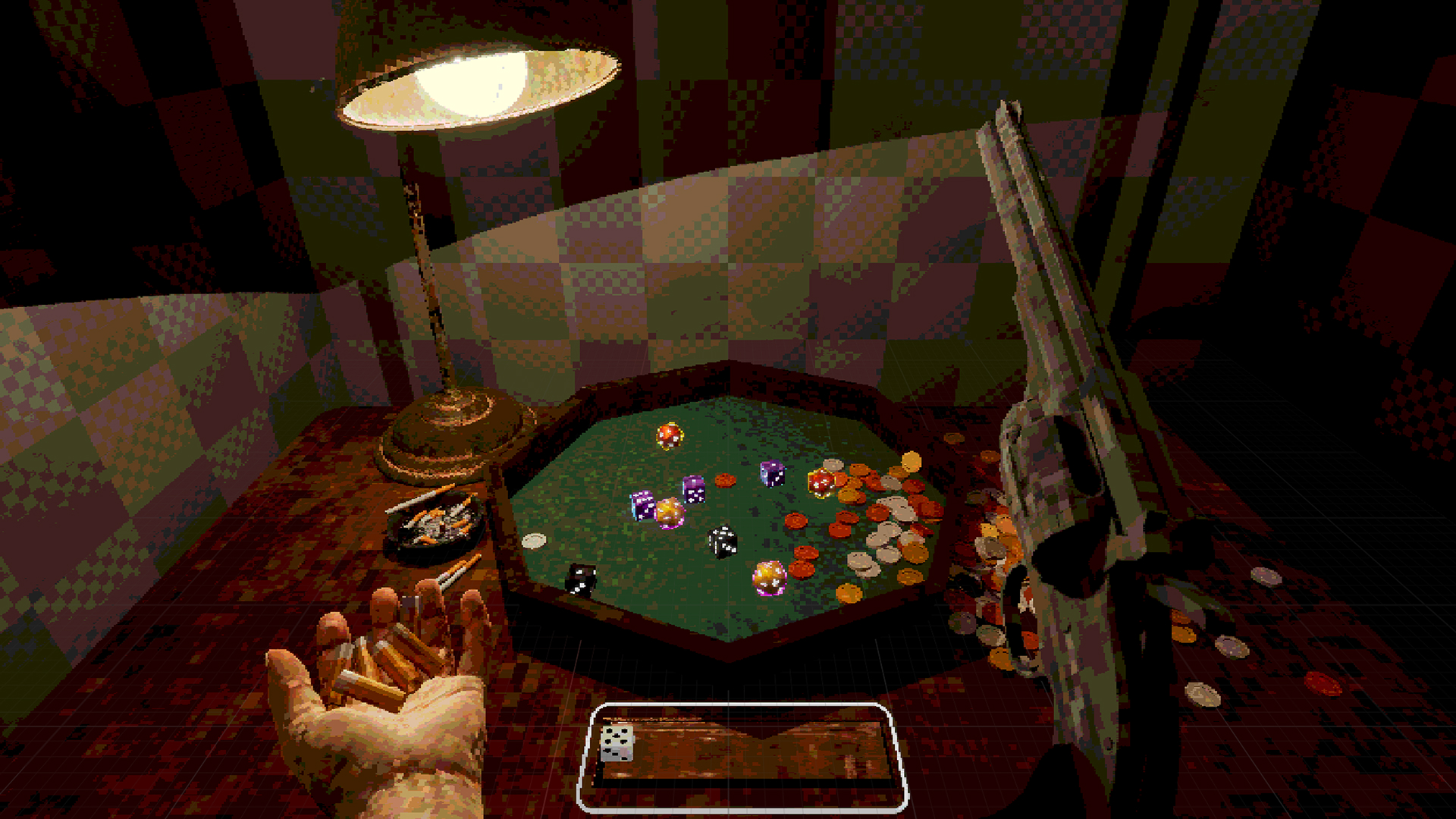
Overview: Top Down to Skeet Shooting
This project was developed for the “Devs Under Duress” game jam in November 2025. Our original pitch was a top down dice rolling game called “Pay The Toll,” where players would try to breach score thresholds across multiple rounds (Definitely inspired by Balatro’s Ante system!). However, as we started developing, the idea evolved into something much more kinetic: a first person shooter where you use a revolver to skeet shoot dice. It was a really fun last minute pivot, and knowing we only had a week to build it forced us to focus purely on the feel and feedback of mechanics. It’s a prototype I am super proud of and absolutely plan to revisit in the future.
Experimentation with Tactility and Physics
Weirdly enough, this jam was my very first real dip into physics in Unreal. We wanted the game to communicate a heavy mechanical feel through both the visual and the mechanics. Almost everything on the player’s tool bench and shop is physically interactable.
This philosophy extended directly into our weapon design. Instead of a simple click to shoot mechanic, the revolver was heavily physicalised:
- The player has to hold the trigger to prime the hammer.
- You can hold R to tilt the gun and physically check the cylinder for remaining rounds.
- Reloading requires manually ejecting casings and loading bullets one by one.
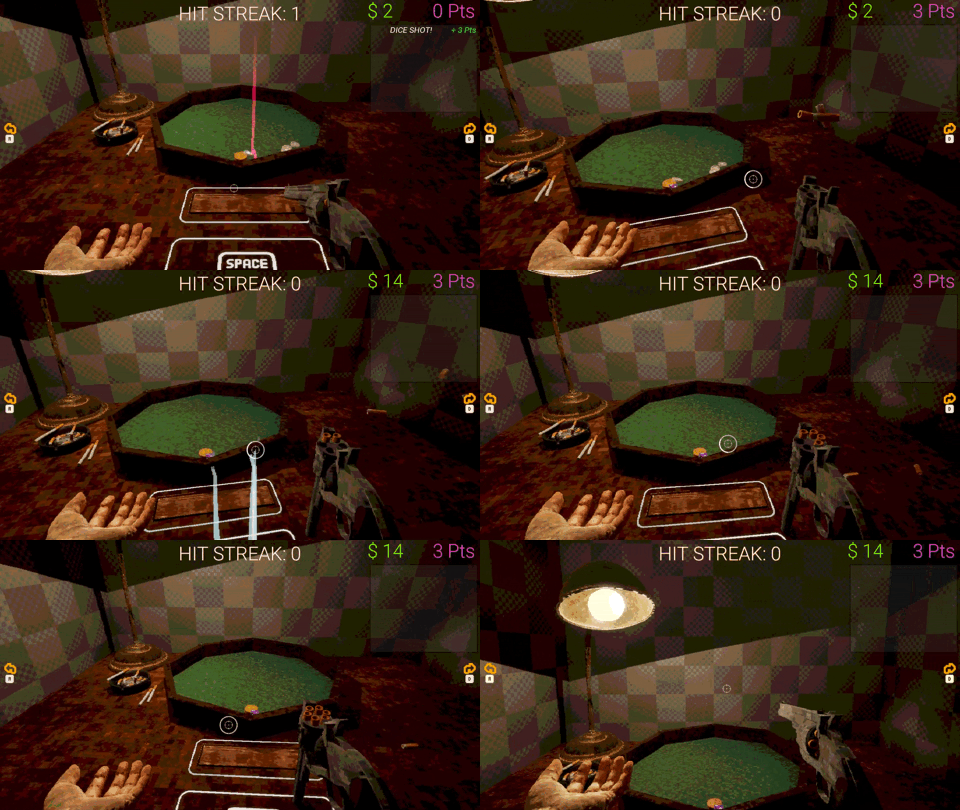
Juggling Dice!
The core gameplay loop starts by using your heavy revolver like a hammer to physically smack the dice into the air. From there a timer starts and it becomes a juggling act.

To make shooting a tiny physics object fun rather than frustrating, I engineered a triple collision system for the bullets. The inner collision sphere handles direct impact effects, while a much larger outer collision sphere applies “wiff” velocity. This means near misses will still catch the dice in their wake, propelling it further into the air, enough to land another shot before the dice falls even lower.
Score is calculated by Time in Air x Shots Hit x Final Landed Number.
The Birth of ProcTex
Beyond the physics and gameplay, this jam was a huge learning experience for Tech Art. We wanted a very specific gritty, rusty, crunchy, color-banded, noisy image. During the jam, I experimented with a procedural material to achieve this look in real time (which wasn’t very wise since performance took a hit, which was a big lesson learned for when it came to rebuilding it in the future).
While the visual results were pretty cool, the shader instructions were in the several hundreds, which totally tanked performance when applied universally. To solve this, I built a system to bake that procedural math down into flat texture maps. That exact optimisation hurdle during this tiny jam laid the basis for the texture pipeline plugin I would later build for SOL CONSTRUCT!
